




News
A Collection Of Restaurant, Food, Drink And Hospitality News From All Over South Africa
Buried in the Kalahari, a restaurant that could exist nowhere else ...
07 October 2026
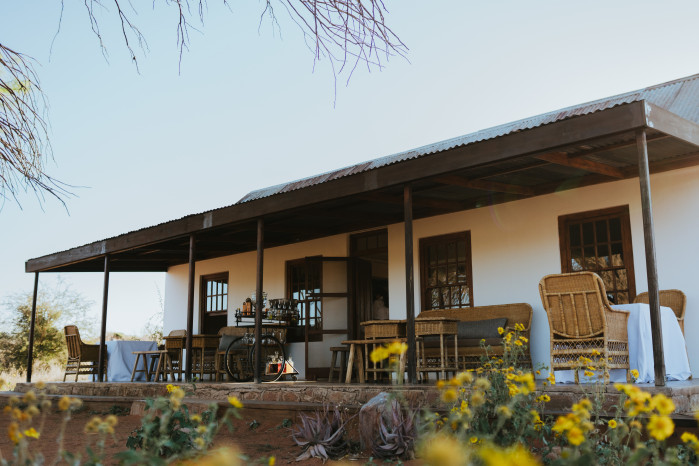
At Tswalu, Luke Dale Roberts has created a restaurant shaped by the landscape rather than imposed upon it — where the Kalahari runs from the earth beneath your feet to the plate in front of you.
There are restaurants with a sense of place, and then there are restaurants that could not exist anywhere else.
Boscia belongs firmly in the latter category.
Built into the earth beneath a century-old farmhouse at Tswalu Kalahari, Boscia opened in August 2026 under the creative direction of Luke Dale Roberts. For the chef behind The Test Kitchen — the restaurant that ranked among the World's 50 Best Restaurants and was named Eat Out Restaurant of the Year six times — it represents something more personal: an opportunity to create a dining experience in which the landscape is not merely the backdrop, but an essential part of the story.
And at Tswalu, there is quite a story to tell.
The restaurant takes its name from Boscia albitrunca, the shepherd's tree that punctuates the semi-arid landscape. Hardy and remarkably adapted to its environment, the tree can send its roots as deep as 68 metres into the earth in search of water. It is a fitting symbol for a restaurant built around ideas of depth, resilience and discovery — where much of what matters lies beneath the surface.
Surrounded by what may be the world's largest congregation of shepherd's trees, Boscia is immersed in the very environment that informs its identity.
A restaurant beneath the earth
The journey into Boscia begins above ground, at Boscia House, a century-old farmhouse where guests are welcomed with snacks and cocktails.
Then the experience moves downwards.
The root cellar is part gallery, part library and part working larder, and perhaps the clearest expression of the thinking behind the restaurant. Shelves are filled with fermented, pickled and preserved ingredients — a living record of the kitchen's relationship with the Kalahari and its seasons.
It is not simply a place where ingredients are stored. It is a place where time becomes an ingredient in itself.
“The root cellar is a living, breathing beast. We hope only to keep feeding it with newness.”
— Alwijn Burger, Creative Director
From there, the architecture shifts again. A gallery is anchored by a life-size bronze interpretation of the shepherd's tree by South African artist Nic Bladen, who lived on the reserve during an artist residency in 2015.
The final transition leads into the dining room.
Here, the earth gives way to glass and sky. The kitchen is exposed through an open pass, while beyond it the Kalahari stretches into the distance.
The restraint is deliberate.
“Restraint is its own kind of theatre. It encourages immersion in the environment without competing with it.”
— Alwijn Burger, Creative Director
It is a philosophy that suits Tswalu. Nothing here needs to shout.
Where the Kalahari becomes cuisine
The five-course menu, led by head chef Dillan Kannemeyer and his team, is rooted in the ingredients and character of the region while reflecting the culinary language of Luke Dale Roberts.
His classical European training and Asian influences meet the Kalahari through venison, tsamma melon, Kalahari salt, local dates and wild rosemary.
Preservation is central to the kitchen's approach, echoing the root cellar and the ancient relationship between people and this unforgiving landscape. Fermentation, pickling and other preservation techniques allow ingredients to be transformed and carried through time, rather than simply consumed at the moment of harvest.
Even the sourcing reinforces the sense of place. As much as 90 percent of the meat is sourced from a butcher based in the Kalahari itself.
The result is not an attempt to reproduce the landscape on a plate. Rather, it is a conversation with it.
South African wine pairings accompany the menu, while non-alcoholic herbal infusion pairings offer another interpretation of the ingredients and flavours of the region.
Designed around the dish
At Boscia, the connection between food and place extends beyond what is edible.
Every object placed on the table was commissioned for a particular dish, created through conversations between the chefs and South African artists and craftspeople including Conrad Hicks, Roché Muller, Wim Botha, Anton Kock and Hadley Craig.
It gives the meal another layer of storytelling.
The restaurant itself is quiet. The tableware is considered. The architecture does not compete with the view.
And gradually, as the light fades over the Kalahari, the distinction between dinner and safari becomes increasingly difficult to draw.
Under a Kalahari sky
The final course is not necessarily the end of the experience.
At the close of the evening, guests are collected beneath a large boscia tree — the living counterpart to the restaurant below the farmhouse.
Behind them, the restaurant has become little more than a narrow strip of light. Above them, the Kalahari night opens out.
It is a fitting conclusion to an experience built around the idea of moving between worlds: above and below ground, wilderness and architecture, ancient landscape and contemporary cuisine.
For Luke Dale Roberts, the significance of Tswalu appears to lie precisely in that connection.
“Tswalu got under my skin very quickly. There is enormous respect for the landscape, for conservation, for creating something meaningful rather than simply impressive. At this stage of my career, that matters to me.”
— Luke Dale Roberts
Jonathan Oppenheimer, whose family has been custodian of Tswalu since 1999, describes the restaurant in similarly measured terms.
“Tswalu has always been a place that rewards patience. Boscia is an expression of that same philosophy. Nothing about it is obvious. Everything about it, we hope, is worth the journey.”
Perhaps that is the most appropriate way to understand Boscia.
It is not simply another destination restaurant attached to a luxury safari property. Its purpose is more integrated than that. The landscape informs the ingredients, the ingredients inform the kitchen, the kitchen informs the objects on the table, and the architecture continually returns the guest to the wilderness outside.
The restaurant does not attempt to compete with Tswalu.
It allows Tswalu to become the restaurant.
The Boscia experience
A dinner at Boscia is included for guests staying two or more nights at Tswalu.
From October 2026, Boscia will also open to the public for Saturday lunch at R3,850 per person. Reservations open on the first day of each month at 08h00 for the following month.
A minimum of 72 hours' cancellation notice is required for public Saturday lunch reservations.
Pescatarian, vegetarian and vegan menus can be accommodated with 72 hours' advance notice, while a children's menu is available with 24 hours' notice.
For Saturday lunch reservations, contact boscia@tswalu.com.
For in-house guest reservations, contact reservations@tswalu.com.
Tswalu Kalahari
Boscia is part of Tswalu Kalahari, a 118,000-hectare private reserve on the southernmost edge of the Kalahari.
The reserve is one of Africa's most biologically significant and remote landscapes and has been under the custodianship of the Oppenheimer family since 1999. Tswalu is malaria-free and comprises three camps: Motse, Loapi and the exclusive-use Tarkuni homestead.
Every guest is allocated a private vehicle, guide and tracker, with unlimited time in the field.
Conservation is at the heart of Tswalu's purpose, and that philosophy runs through the entire experience — from the wilderness itself to a restaurant buried beneath the earth.
At Boscia, the journey simply ends where it began: with the Kalahari.
Learn more: Visit: https://tswalu.com/experience-tswalu/boscia/